



Rabies-positive bat found in Tuscarawas County

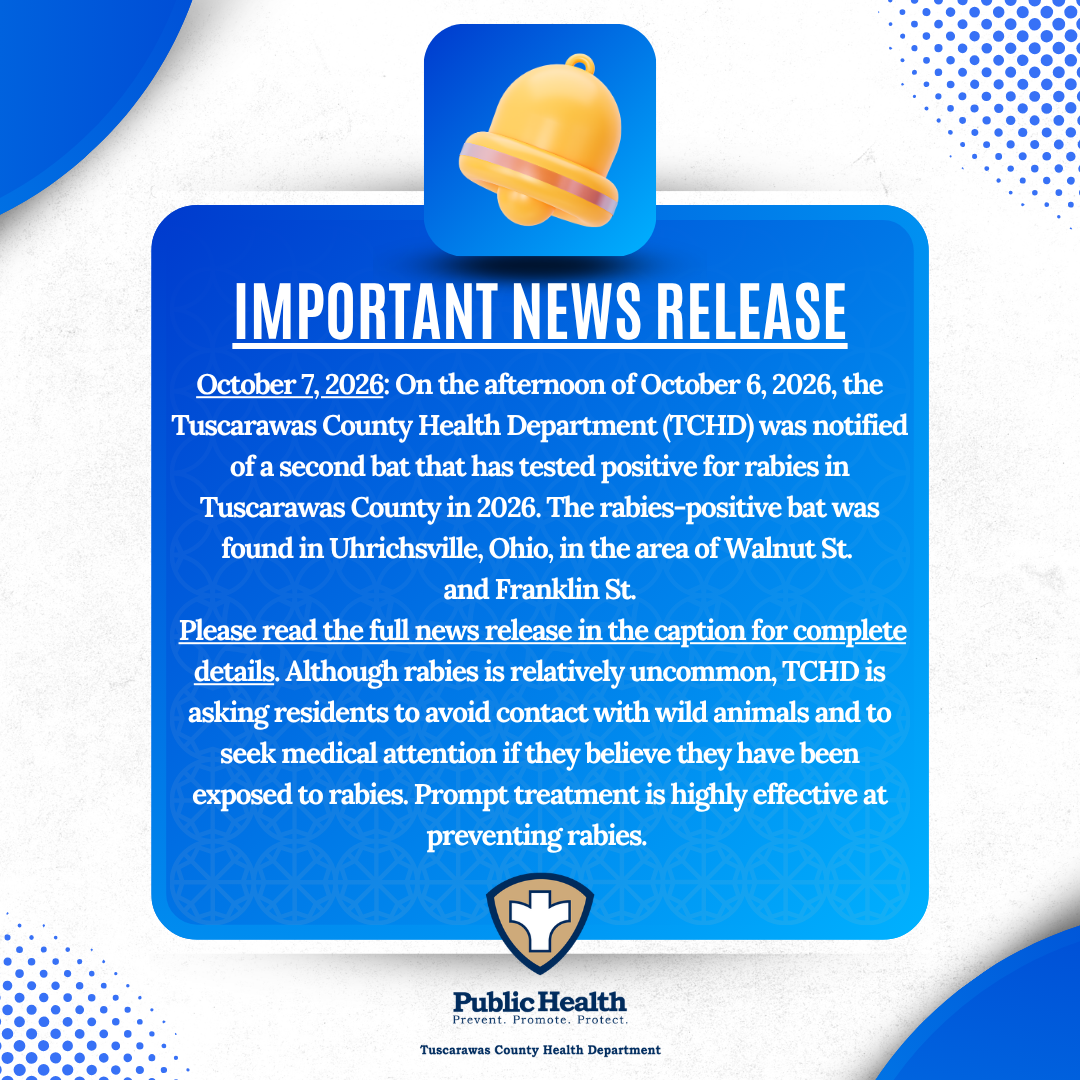
UHRICHSVILLE – Health officials have found a rabid bat in Tuscarawas County for the second time this year.
The Tuscarawas County Health Department reports the second bat that tested positive for rabies was in Uhrichsville near Walnut and Franklin streets.
The first was discovered in April in Dennison.
Health officials say bats are the most common source of exposure to rabies, a serious and potentially fatal disease that attacks the central nervous system. They ask residents to avoid contact with wild animals and seek medical attention immediately if they believe they have been exposed.
Rabies is most often spread through an animal bite. Bat bites are small and hard to detect, so health officials say people should contact a health provider if they find a bat indoors.
PRESS RELEASE FROM TUSCARAWAS COUNTY HEALTH DEPARTMENT
Second Rabies-Positive Bat Confirmed in Tuscarawas County
DOVER – On the afternoon of October 6, 2026, the Tuscarawas County Health Department (TCHD) was notified of a second bat that has tested positive for rabies in Tuscarawas County in 2026. The rabies-positive bat was found in Uhrichsville, Ohio, in the area of Walnut Street and Franklin Street. The first rabies-positive bat identified in Tuscarawas County this year was reported in April and was found in Dennison, Ohio.
Rabies is a serious and potentially fatal disease caused by a virus that attacks the central nervous system, including the brain and spinal cord. Although rabies is found most often in wild animals like bats, skunks, and raccoons; it can infect any mammal, including pets and humans. The virus is spread through the saliva of an infected animal, typically via a bite or contact with an open wound or mucous membranes, such as the eyes, nose, or mouth.
“Although rabies is relatively uncommon, exposure to a rabid animal requires prompt medical evaluation,” explained Katie Seward, MPH, MBA, Tuscarawas County Health Commissioner. “We want to remind residents to avoid contact with wild animals and to seek medical attention right away if they believe they have been exposed. Prompt treatment is highly effective in preventing rabies.”
Bats are the most common source of rabies exposure in Ohio. Because bat bites can be small and difficult to detect, residents should exercise caution if a bat is found indoors, especially in situations involving sleeping individuals, children, or pets.
TCHD encourages residents to follow these safety precautions:
- Avoid contact with wild or stray animals.
- Never approach animals that appear sick, injured, or dead.
- Report unusual animal behavior to local authorities.
- Bat bites can be very small and may not always be noticed. Anyone who wakes up to find a bat in a room where they were sleeping, or who believes they may have had direct contact with a bat, should contact a healthcare professional or the health department for guidance.
TCHD reminds residents to take the following steps if they see a bat:
- Never handle a bat with bare hands.
- Keep children and pets away from bats.
- If a bat is found inside a home, do not release it before contacting your local health department or animal control, particularly if there is any possibility that a person or pet was exposed.
- If you are bitten or scratched by a bat, immediately wash the affected area thoroughly with soap and water and seek medical attention.
- Contact your veterinarian if you believe your pet may have had contact with a bat.
- Make sure dogs, cats, and ferrets are current on their rabies vaccinations. As a reminder, pursuant to Ohio law, the Tuscarawas County Health Department requires all dogs and cats over the age of 3 months to be vaccinated against rabies.
Residents with questions about a possible rabies exposure should contact TCHD at (330) 343-5555. For more information about rabies, visit https://www.tchdnow.org/animal-bite-investigation.html